
''Beautiful leather is rarely the result of using more product. It comes from reading the leather correctly, choosing the gentlest effective treatment and applying each layer with patience.''
That is the method I have always shared with The Elegant Oxford community: observe first, work sparingly and let each step earn the next. My aim is not simply to help you produce shinier shoes, but to give you the confidence to understand what the leather is asking for.

Start here
Choose the right level of care
Think of these as three levels of intervention, not three stages that every pair must complete. Do not deep-clean leather that only needs brushing and a thin layer of shoe cream. Select the description that most closely matches what you see.
Routine care
Dust, a dull surface, fine creases or a little dryness, with no visible buildup or stubborn staining.
Follow routine careModerate cleaning
Everyday soil, uneven dullness, light marks or a modest layer of old cream and wax polish.
Follow moderate cleaningDeep cleaning
Stubborn contamination or accumulated wax, silicone or resin that Cleanser has not removed.
Follow deep cleaningBefore you begin
Is this the right guide for your leather?
Before we reach for a jar or brush, we must identify the surface correctly. This method is written for dry, finished smooth leather. That includes most traditional dress shoes and many smooth-leather boots, bags and accessories. If the surface is velvety, highly glossy, heavily oiled, coated or unusually absorbent, it needs a material-specific routine.

Use this guide for
- Smooth calfskin and box calf
- Finished full-grain and top-grain leather
- Pigmented or corrected-grain smooth leather
- Pebbled, Scotch-grain and other finished grained leather
- Compatible smooth-leather shoes, boots, bags and accessories
Consult our guide page for
- Suede, nubuck, velour and roughout
- Patent, metallic, pearlescent, painted or laminated leather
- Shell cordovan, reptile, fish leather and shagreen
- Chromexcel, pull-up, waxed and oiled leather
- Very soft nappa, lambskin, unfinished or highly absorbent leather
Not sure what you have? Do not choose a cleaner by appearance alone. Check the care instructions or ask us with clear photographs taken in natural light before proceeding.
Diagnosis before products
Read the leather first
Use a Horsehair Brush to remove loose dust, then inspect the surface in good, neutral light. The condition—not the calendar—should decide the routine. This small pause is what turns product use into genuine shoe care.

| What you see | What it usually needs | Where to begin |
|---|---|---|
| Dust or mild dullness | A Horsehair Brush for gentle dusting, followed—only if needed—by one thin layer of Crème 1925 Pommadier Cream or Crème Surfine Shoe Cream | Routine care |
| Dry feel or pale creases | A light application of Rénovateur Cream, followed by Crème 1925 Pommadier Cream or Crème Surfine Shoe Cream only if colour or shine needs refreshing | Routine care |
| Light grime or excess polish | Cleanser before Rénovateur Cream, Crème 1925 Pommadier Cream or Crème Surfine Shoe Cream | Moderate cleaning |
| Heavy buildup or stubborn contamination | A controlled deep clean with Reno Cleaner, then nourishment and a rebuilt finish | Deep cleaning |
| Scratches, gouges, cracking or peeling | Repair or colour restoration; Cleanser, shoe creams and wax polishes cannot rebuild missing structure | See the Repairing & Recolouring Smooth Leather Guide |
Cleanser can remove everyday contamination. Rénovateur Cream can improve suppleness. Crème 1925 Pommadier Cream or Crème Surfine Shoe Cream can soften the appearance of light fading and superficial scuffs. None of them can replace torn leather, rebuild a deep gouge or fix a cracked leather.
A considered kit
Your smooth-leather care toolkit
A thoughtful kit is not a crowded kit. Keep a dependable set of core tools ready, then choose one treatment path according to the leather's condition. This is how we work in The Elegant Oxford community: every product should have a clear purpose before it touches the leather.

Core tools
- A clean Horsehair Brush for gentle dust removal and the final, higher-lustre buff
- A Polishing Brush with firmer boar bristles for textured grain, removing dried excess product and developing a refined shine
- Cotton Chamois Cloths, with separate areas for cleaning, application and final buffing
- Well-fitting Cedar Shoe Trees for your footwear
- A Small Spreading Brush or Pommadier Brush for welt seams and tight areas
Choose products by purpose
Use Crème 1925 Pommadier Cream or Crème Surfine Shoe Cream when the leather needs colour support and a more polished finish. Use Crème Universelle Leather Balm or Nourishing Lotion (also available with Macadamia Oil) to maintain the leather´s suppleness.
Use Rénovateur Cream sparingly. Do not add it automatically when the chosen Crème 1925 Pommadier Cream or Crème Surfine Shoe Cream already provides enough nourishment.
Choose Gentle Cleanser or Cleaning Lotion to lift light grime and excess product while preserving the finish.
Reserve Reno Cleaner or Réno'mat for stubborn contamination or accumulated wax, silicone and resin—not ordinary weekly care.
Brush discipline matters. Neither the Horsehair Brush nor the Polishing Brush should be used on suede, nubuck, velour, patent leather, delicate exotics, textile or coated surfaces. Do not brush wet leather, fresh mud, grease or abrasive grit: trapped particles can mark the finish. Remember to clean your brushes to avoid unwanted product or color transfer, use Wax Softener & Brush Cleaner when required.
The small test that prevents large mistakes
How to patch test correctly
I know the patch test is the easiest step to feel tempted to skip. It is also the step that allows us to proceed with confidence, particularly on an unfamiliar finish or colour.
-
Choose a concealed area
For shoes, use the inner heel or another discreet section made from the same leather. Avoid testing on lining leather or a different panel.
-
Use the smallest practical amount
Apply the product exactly as you intend to use it on the visible surface. More product does not make the test more informative.
-
Let it dry fully
Judge the test only after the product has dried and been buffed. Wet leather often appears darker than the final result.
-
Check colour, feel and finish
Proceed only if the leather remains even, supple and stable. Stop if colour lifts, the surface becomes tacky, the finish clouds or the area darkens unpredictably.
Level 1
Routine care: dust, nourish and polish
Most well-kept shoes should spend their lives at this level. This is the right routine for leather that is fundamentally clean and healthy, restoring refinement without disturbing a sound existing finish.
-
Prepare the footwear
Remove the laces and insert correctly sized Cedar Shoe Trees. The trees should support the form, not stretch it. If the shoes were just worn, allow them to release heat and moisture before applying product.
-
Remove loose dust
Brush the dry leather with a Horsehair Brush using light, brisk strokes. Pay attention to creases, seams and the junction between the upper and welt. On pronounced grain, a Polishing Brush can provide a little more action. Use a Cotton Chamois Cloth for areas a brush cannot safely reach.
-
Choose one appropriate care product
Use Crème Universelle Leather Balm for simple maintenance, Rénovateur Cream if the leather feels dry, or Crème 1925 Pommadier Cream or Crème Surfine Shoe Cream when you want nourishment with colour renewal and polish. A healthy pair rarely needs all three in the same session.
Check our Colour Guide to choose the perfect shade. -
Apply a thin layer
Touch only the tip of a Cotton Chamois Cloth or Pommadier Brush to the product. Massage it evenly until the layer nearly disappears into the leather. Keep excess away from perforations, stitching and decorative details.

-
Allow the product to settle
Follow the product's stated drying time. As a practical check, the surface should feel dry rather than tacky before buffing.
-
Buff to the desired finish
Use a Polishing Brush when you want firmer action to remove dried excess cream or wax and establish a refined intermediate shine. Follow with a clean Horsehair Brush using quick, light strokes when you want a softer, higher-lustre finish. A Cotton Chamois Cloth or Woollen Shining Pad can refine it further. Add Pâte de Luxe Wax Polish only if you want more gloss or focused protection.

Crème Universelle Leather Balm maintains the existing tone but will not replace missing pigment. A matching shade of Crème 1925 Pommadier Cream or Crème Surfine Shoe Cream can revive faded colour and soften superficial scuffs while preserving the leather's character. If you are between two shades, the lighter option is usually more forgiving. Always patch test.
Level 2
Moderate cleaning: reset without stripping
This is where restraint matters most. Use this method for visible everyday grime, uneven dullness or modest product buildup. The goal is to clean the surface sufficiently—not to remove every trace of the existing finish.
-
Prepare and dry-brush
Remove the laces, insert Cedar Shoe Trees and use a Horsehair Brush to remove all loose dust. Never rub Cleanser over grit.
-
Patch test Cleanser
Use a concealed section of the same leather. Pay particular attention to light colours, hand-finished patinas and unfamiliar finishes.
-
Clean with a cloth, not directly from the container
Place a small amount of Gentle Cleanser or Cleaning Lotion on a clean Cotton Chamois Cloth. Work one small section at a time with controlled circular motions, turning the cloth frequently so lifted soil is not spread back over the leather.

-
Let the leather dry and reassess
Do not judge colour while the surface is damp. Once fully dry, decide whether it genuinely needs Crème 1925 Pommadier Cream or Crème Surfine Shoe Cream, or simply a thorough buff.
Check our Colour Guide to choose the perfect shade. -
Rebuild only what was removed
If the leather feels dry, use a light application of Rénovateur Cream. If the colour looks tired, apply a matching shade of Crème 1925 Pommadier Cream or Crème Surfine Shoe Cream. Use a Polishing Brush to clear dried excess and develop the first shine, then finish with a clean Horsehair Brush or Cotton Chamois Cloth.
One cleaner at a time. Do not combine Gentle Cleanser or Cleaning Lotion with another cleaner or immediately escalate because the first pass did not remove a mark. Let the leather dry, inspect the result and repeat the process if needed.
Level 3
Deep cleaning: remove stubborn residue, then rebuild
Deep cleaning has its place, but it should feel like a considered decision rather than a reflex. Reserve it for persistent contamination or layers of old wax, silicone or resin that interfere with an even finish. It is not the default first step in a shine.
-
Confirm that deep cleaning is justified
If the surface is merely dusty, dull or lightly marked, return to a gentler routine. Deep cleaning can remove parts of the finish as well as unwanted buildup.
-
Prepare and test
Work in a ventilated area, remove laces, insert Cedar Shoe Trees and dry-brush carefully with a Horsehair Brush. Patch test on the same finished leather and allow the test to dry fully.
-
Use a small amount on a clean cloth
Apply Reno Cleaner or Réno'mat to a Cotton Chamois Cloth rather than pouring it onto the leather. Work in small circular motions and continually move to a clean part of the cloth as residue lifts.
-
Allow at least 15 minutes to dry
Let the leather dry completely, then inspect it in neutral light. Repeat only where necessary and only if the surface remains stable.
-
Restore nourishment
Deep cleaning prepares the leather; it does not condition it. Apply Rénovateur Cream in a very thin layer, allow it to settle and buff.

-
Rebuild colour and protection gradually
Apply Crème 1925 Pommadier Cream or Crème Surfine Shoe Cream sparingly, let it dry and buff. Add Pâte de Luxe Wax Polish in thin layers, concentrating on the firmer toe and heel areas if a brighter finish is desired.
Check our Colour Guide to choose the perfect shade.
Décapant Leather Stripper and Teinture Française Leather Dye belong to controlled recolouring work, not ordinary cleaning, scuff care or patina maintenance. If the goal is a permanent colour change, follow a dedicated dyeing guide and confirm leather compatibility first.
Protect the result
Aftercare and sensible frequency
The best-cared-for shoes are not necessarily the ones treated most often. There is no universal weekly or monthly schedule: climate, wear, storage, leather finish and previous treatments all matter. Let the surface tell you what it needs.
| Moment | Good practice | Avoid |
|---|---|---|
| After wear | Allow moisture to dissipate, insert Cedar Shoe Trees and use a Horsehair Brush for gentle dusting, or a Polishing Brush when textured grain needs firmer action. | Sealing damp shoes in a box or applying Crème 1925 Pommadier Cream or Crème Surfine Shoe Cream while warm and moist. |
| When dull or lightly dry | Use Crème Universelle Leather Balm, Rénovateur Cream, Crème 1925 Pommadier Cream or Crème Surfine Shoe Cream as appropriate, followed by a thorough buff. | Layering Rénovateur Cream, Crème 1925 Pommadier Cream or Crème Surfine Shoe Cream, and Pâte de Luxe Wax Polish by habit. |
| When visibly dirty | Select Cleanser or, for a justified deep clean, Reno Cleaner, then reassess after drying. | Deep-cleaning merely because time has passed. |
| After rain | Blot gently, reshape and dry at room temperature away from direct heat. | Radiators, hairdryers, aggressive rubbing or product on wet leather. |
For a higher shine, apply Pâte de Luxe Wax Polish only after the Crème 1925 Pommadier Cream or Crème Surfine Shoe Cream layer is dry and polished. Keep Pâte de Luxe Wax Polish particularly thin over flex points; heavy buildup in creases can crack and flake.
Quiet technique, better results
Common mistakes to avoid
These are the small habits I correct most often. None is dramatic on its own, but avoiding them is what makes a routine cleaner, safer and more consistent.
- Cleaning every time you polish. Most routine sessions begin with the appropriate dry brush and end with Crème 1925 Pommadier Cream or Crème Surfine Shoe Cream as needed, followed by a considered buff.
- Using too much product. Thick layers dry unevenly, collect in seams and can make the surface sticky or cloudy.
- Applying Cleanser or Reno Cleaner directly to the leather. Dose it onto a Cotton Chamois Cloth for better control.
- Skipping the patch test. Even familiar products can behave differently on another finish or colour.
- Using one brush for every material, stage and colour. Keep smooth-leather tools separate from suede tools, distinguish a firmer Polishing Brush from a softer finishing Horsehair Brush, and separate very light from dark polish where transfer matters.
- Trying to polish structural damage away. Deep gouges, peeling finishes, torn seams and cracking require repair assessment.
- Forcing the drying process. Direct heat can harden, shrink or distort leather.
- Assuming neutral means invisible. Neutral Crème Universelle Leather Balm, Crème 1925 Pommadier Cream and Crème Surfine Shoe Cream can still darken absorbent leather or leave residue when overapplied.
Build only the routine you need
Recommended tools and treatments
These options cover the three care levels without forcing every product into one routine. Choose according to the diagnosis above. Learning why a tool belongs in the routine is part of becoming a more confident member of our shoe-care community.
For gentle dry dust removal and the final soft, higher-lustre buff on compatible smooth or grained leather.
Also available in an oval shape (Oval Horsehair Brush).
For firmer cleaning action on textured grain, removing dried excess cream or wax and developing a refined intermediate shine before the final horsehair buff.
View polishing brushFor controlled application of the selected treatment, lifting soil and refining the final finish.
View clothFor supporting the shoe's shape and helping it release residual moisture between wears.
View shoe treesA simple neutral option for gentle cleaning, conditioning, protection and a natural shine.
View balmA dedicated conditioning foundation for smooth leather that feels dry or undernourished.
View conditionerFor nourishment, colour renewal, protection and an elegant polished finish on fine smooth leather.
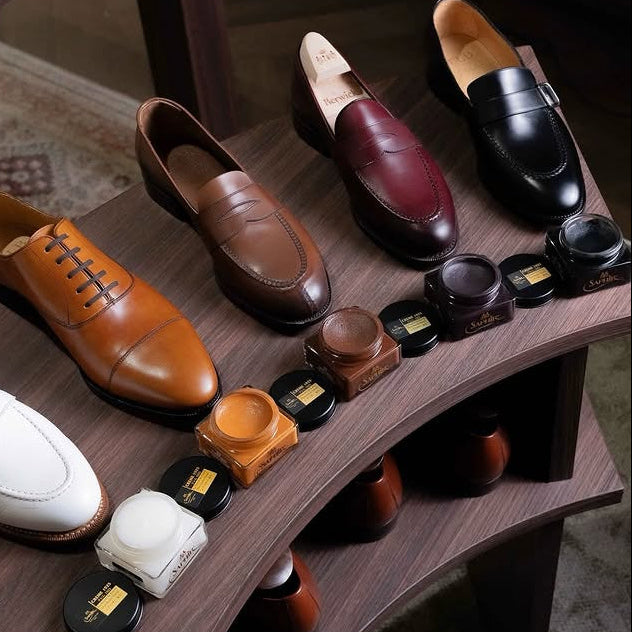
View shoe creamA classic pigmented cream for routine nourishment, colour maintenance and polish.
View shoe creamA gentle choice for everyday soil and excess wax polish when the Horsehair Brush alone is not enough.
View gentle cleanerA deep cleaner reserved for stubborn contamination and accumulated wax polish, silicone or resin.
View deep cleanerCompare Saphir shades before choosing Crème 1925 Pommadier Cream or Crème Surfine Shoe Cream. Product compatibility and a patch test still come first.
Find your shadeThe questions we hear most
Smooth-leather care, answered
Should I use a Horsehair Brush or a Polishing Brush?
Use the softer Horsehair Brush for gentle dust removal and the final higher-lustre buff. Choose the firmer boar-bristle Polishing Brush when you want more action on textured grain, need to clear dried excess cream or wax, or want to establish a refined intermediate shine. Many careful routines use both in sequence rather than treating them as interchangeable.
How often should I condition smooth leather?
Condition by need, not by a rigid date. Leather that feels dry, looks pale at the creases or has lost suppleness may benefit from a light application of Rénovateur Cream. Leather that remains supple and balanced may need only a Horsehair Brush and occasional Crème 1925 Pommadier Cream or Crème Surfine Shoe Cream. Over-conditioning can oversoften the structure and leave residue.
Do I need cleaner before every polish?
No. Begin with a Horsehair Brush. If the leather is clean, apply a very thin layer of Crème 1925 Pommadier Cream or Crème Surfine Shoe Cream only when needed and buff. Use Cleanser for actual soil or product buildup, and reserve Reno Cleaner for a genuine corrective clean.
Should I use a neutral or coloured cream?
Neutral Crème 1925 Pommadier Cream or Crème Surfine Shoe Cream maintains and conditions without deliberately adding pigment, but it cannot replace lost colour. A closely matched pigmented shade of either cream is better for faded tone and superficial colour loss. Choose conservatively, consult The Elegant Oxford Colour Guide and test in a concealed area.
Can shoe cream repair scratches?
Crème 1925 Pommadier Cream or Crème Surfine Shoe Cream can reduce the appearance of light surface scuffs by restoring pigment and polish. Neither can fill a deep cut, rebuild missing grain or repair cracking. Structural or deep damage needs a repair-specific assessment. Refer to our other guides for additional information.
Can I use this routine on a leather bag or jacket?
The same assessment-first principle applies to compatible finished smooth leather, but bags and garments often use softer leather and larger panels that can reveal uneven application. Confirm the exact finish, test discreetly and apply even less product. Do not use Pâte de Luxe Wax Polish on flexible garments.
What should I do if the leather becomes much darker?
Stop, remove any surface excess gently with a clean Cotton Chamois Cloth and allow the item to dry fully at room temperature. Do not add another product in an attempt to correct it while wet. If the colour remains uneven or the finish changes, ask for material-specific advice before continuing.
